India’s data protection law is not about paperwork. It is about who owns the relationship between a brand and its customer—and how Easyrewardz is helping brands bridge that trust gap.
For years, Indian brands ran their customer databases like a digital ‘catch-all’: collect everything, sort it later, and delete nothing. A mobile number captured at a retail checkout or an email ID pulled from a forgotten loyalty sign-up sat quietly in CRM systems, powering campaigns and personalization. Nobody questioned the arrangement until now.
The Digital Personal Data Protection (DPDP) Act, notified by MeitY, has fundamentally rewritten the rules of engagement. It works on a singular, disruptive principle: a customer’s data belongs to the customer (the Data Principal), and the brand is merely a custodian (the Data Fiduciary). Every time a brand processes that data, it needs explicit, purpose-specific, opt-in consent.
With penalties reaching Rs 250 crore and a compliance deadline of May 2027, the stakes couldn’t be higher. Yet, for Easyrewardz, this isn’t a new conversation. As a data custodian for over 250 retail brands and Fortune 500 companies, it has spent a decade building the “bricks of intelligence” for modern retail. With a commitment to security and a flawless record of zero data breaches, it fosters trust and innovation in the industry. Now, it is evolving that expertise into a specialized infrastructure layer OneConsent by Zence.
The company is certified under ISO/IEC 27001:2022 and ISO/IEC 27701:2019, along with PCI DSS compliance, ensuring audited security, privacy governance, and structured data controls at scale. In the DPDP era, this foundation is not cosmetic; it is critical infrastructure.
Consent begins at the point of transaction
To understand why Easyrewardz is leading this shift, one must look at the broad ‘identity capture engines’ of a brand. The consent journey now begins across multiple operational touchpoints: POS, digital receipts, SMS microsites, and checkout flows.
In the offline world, handing over a mobile number during a transaction for an e-bill is a voluntary disclosure that creates a data footprint. The critical change under DPDP is that consent must be embedded directly into this infrastructure. The flow is now clear: transaction leads to number capture, which generates a digital receipt and a microsite link, where explicit consent is captured before any communication is triggered.
“In a rapidly expanding data universe, brands cannot afford blind spots. We help them prepare for a consent-first world — engineering visibility, control, and accountability into the core of their technology stack so trust scales as fast as growth, ” Soumya Chatterjee, CEO of Easyrewardz, explains.
Data that was once a growth lever now poses a liability under DPDP if not managed properly. Every outbound communication, from birthday discounts on WhatsApp to personalized app offers, requires verified, purpose-specific consent. Proposed rules mandate real-time API checks before launching campaigns, and consent older than six months without re-verification is non-compliant.
Easyrewardz SaaS platform, Zence, has been integral in managing CRM and customer engagement. Recognizing that compliance must be seamlessly integrated, Zence ensures it is embedded in the brand’s technology rather than treated as a separate system.
Why fragmentation fails — And OneConsent wins
The biggest operational nightmare for Indian brands isn’t getting consent, it’s keeping track of it. Most mid-to-large brands operate on a patchwork of legacy systems: a POS for billing, a separate loyalty engine, a CDP for marketing, and perhaps a third-party agency for digital ads.
If a customer walks into a store and says, ‘Stop sending me offers,’ where does that request go? If your consent records are scattered across various platforms, your audit trail is broken. Under the DPDP Act, if you cannot prove you had consent, the law assumes you didn’t. Furthermore, fiduciaries are mandated to report data breaches to the Data Protection Board (DPB) within 72 hours.
This is where Easyrewardz provides a massive structural advantage. Unlike standalone Consent Management Platforms (CMPs) that require complex, separate integrations to talk to your marketing tools, OneConsent is natively built on top of Zence’s enterprise-grade Customer Data Platform (CDP).
By embedding the CMP directly into the CDP, the consent layer acts as a secure, real-time gateway. Outbound communication is triggered only after the CMP verifies active, explicit consent. This native integration prevents the chaos of trying to reconcile fragmented data and ensures that a withdrawal on a website is instantly recognized by the physical store app and the marketing engine.
What a DPDP-Ready infrastructure looks like
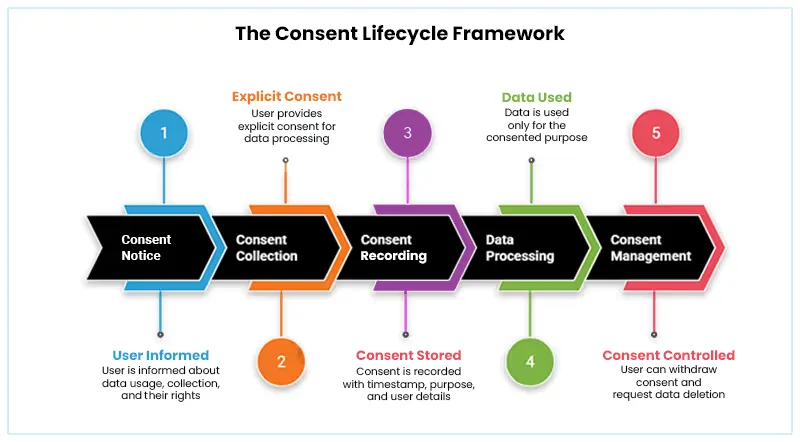
Through OneConsent by Zence, Easyrewardz is defining the new standard for compliant data infrastructure. It isn’t just about an ‘I agree’ checkbox; it is a full lifecycle management system:
- Purpose-level capture: Recording specific permissions for marketing, transactions, or reminders separately.
- OTP-backed validation: Every consent is secured and recorded via an OTP, creating an irrefutable digital footprint.
- Real-time enforcement: Using APIs and webhooks to ensure that every campaign is validated against the latest consent status in the CMP, ideally two to four hours before any message is sent.
- Right to be forgotten: Managing automated data deletion (anonymization) requests with double-confirmation workflows to prevent accidental loss of loyalty benefits.
- Nomination & grievance: Enabling users to nominate others to claim benefits—a unique DPDP mandate—and providing a dedicated grievance portal with clear SLAs.
Beyond the tools: consulting and AI
Easyrewardz isn’t just handing brands a software dashboard; it is acting as a consulting partner. Transitioning to this new era requires a structured approach across four critical lifecycle phases: Discovery (data mapping and gap assessment), Deployment Plan (solution design and roadmap), Deployment (platform implementation and training), and Certification & Scaling (readiness validation and audit support).
“DPDP compliance is the new ‘open for business’ signal in the digital economy. Brands that get this right can engage customers and run marketing without disruption. The ones that don’t will find themselves locked out of their own customer base,” says Tejas Kadakia, Co-founder & Director of Easyrewardz.
The team works with brands through this lifecycle to map data collection points and define purposes according to the law. A major focus is ‘legacy data’, advising brands on how to send proper notices to existing customers to transition them into the new regime without losing the database. The differentiator is the AI-powered layer in OneConsent, designed as a proactive watchdog to auto-detect potential violations and flag non-compliant flows before they become breaches.
Industry momentum: Consent as infrastructure
This shift is not a niche concern. Major industry players like TCS and Reliance Jio are already moving to apply for ‘Consent Manager’ permits—neutral platforms acting as intermediaries between customers and brands. The compliance-as-a-service market in India is projected to reach Rs 1,000 crore over the next three years. As these government-registered Consent Managers go live, brands will need an interoperable system that can sync with them seamlessly. Easyrewardz is positioning OneConsent to be that bridge.
Careful today, carefree tomorrow
In the context of DPDP, ‘carefree’ is a state of mind. If a brand has done the hard work of mapping its data flows and installing a robust consent layer today, it can afford to be carefree post-May 2027. It will know its ROI is protected and customer relationships are built on verified trust.
The DPDP Act is not asking brands to stop using data; it is asking them to earn the right to use it. Brands that treat this as a checkbox exercise will find that their compliance doesn’t survive its first audit. But for those who partner with an experienced custodian like Easyrewardz, this transition is an opportunity to turn data liability into a long-term competitive advantage. In the new digital economy, consent is the currency of trust.
Published Link: https://yourstory.com/2026/03/dpdp-structural-shift-easyrewardz-reimagining-modern-crm-oneconsent